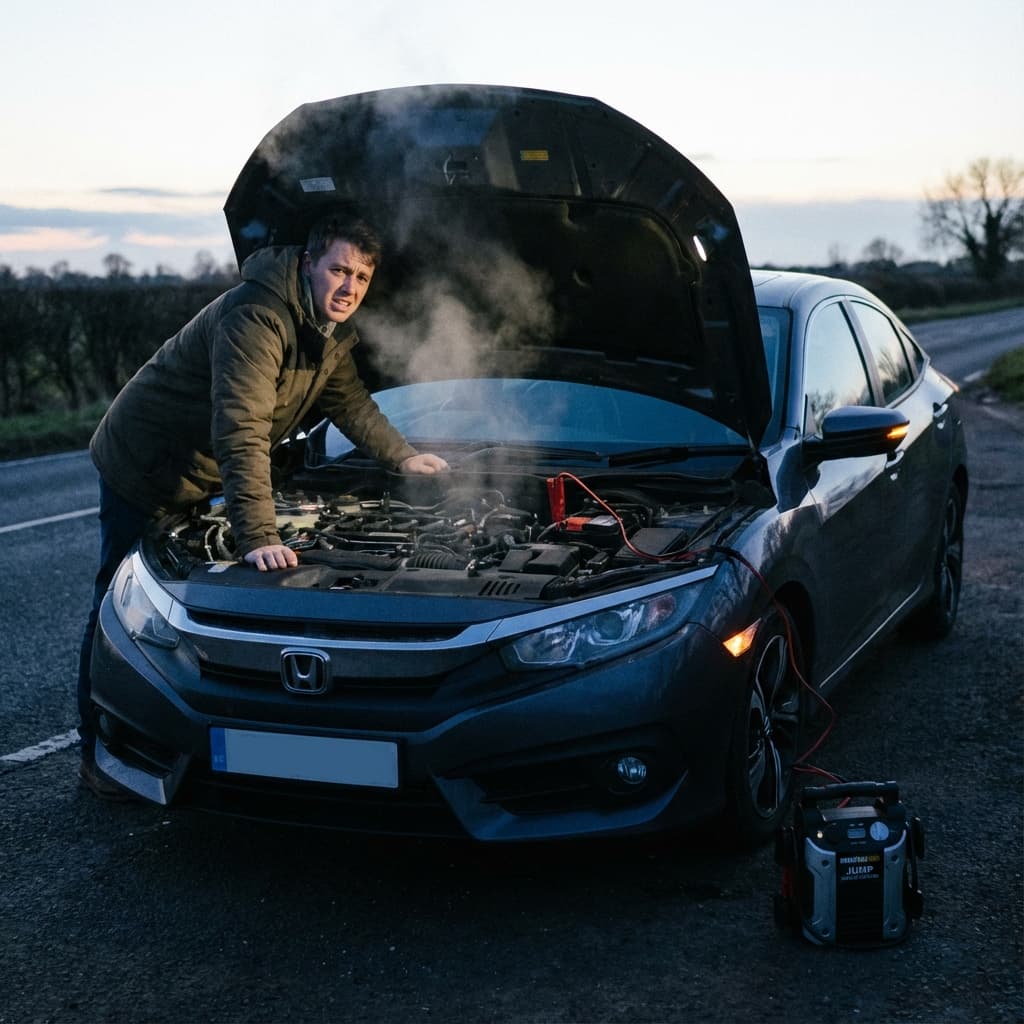
Quick Answer
Common causes
- -Interior or boot lights left on overnight
- -Alternator output below 13.7V due to worn belt or regulator
- -Battery older than 4-5 years with sulphated plates
Typical fixes
- -Use a Cold Cranking Amps (CCA) performance
- -Check parasitic drain (<50mA is typical); fix drains before replacing batteries
- -Replace with the correct technology (AGM}}/{{EFB) if capacity stays under 70%
At-a-Glance Symptoms
Diagnose the Difference Between Flat and Dead
Rapid Symptoms Checklist
- Slow crank that speeds up with a booster pack indicates a flat battery
- Single click with full interior lighting points to a dead cell inside the battery
- Multiple clicks and dim lights often combine a weak battery with poor terminal contact
- Everything goes black when you turn the key - check the main ground strap
- Start happens but infotainment resets itself - voltage dipped below 9V during crank
Interior Light and Accessory Test
Battery Age and Service History
Voltage and Load Test Procedure
Recharge Safely Before You Replace
- Aim for a slow 4-6 amp charge for at least 8 hours
- Let the battery rest for 12 hours after charging before retesting
- Log the readings - resting voltage, loaded voltage, alternator output - so you can spot trends
Post-Charge Checks and Anchor Links
Replacement Triggers You Should Not Ignore
| If {{cold cranking amps | CCA}} tests at under 70% of rated value after charging, the battery is near the end |
|---|---|
| Start/Stop}} cars, replace like-for-like and register the new battery if the vehicle requires it |
- Any sign of a cracked case or corrosion trails warrants immediate replacement
Special Note for Start/Stop Vehicles
When to Get a Professional Diagnosis
Recommended Tools & Gear
These tools can help you diagnose, maintain, or fix battery-related issues. We only recommend products we believe are genuinely useful for your situation.
AstroAI
AstroAI Digital Multimeter
Accurately measures battery voltage to determine if it's dead or just flat. Easy to use and essential for every glovebox.
Best for:
- •Testing battery voltage at home
- •Diagnosing electrical problems
- •Checking alternator output
Basic multimeters are sufficient for battery testing. Professional-grade models available for advanced diagnostics.
ANCEL
ANCEL BA101 Battery Tester
Professional-grade load tester that tells you 'Good', 'Recharge', or 'Replace' in seconds. Checks cranking amps and internal resistance.
Best for:
- •Accurate battery health assessment
- •Pre-purchase battery testing
- •Diagnosing intermittent starting issues
Professional load testers provide the most accurate results, but basic voltage testing is often sufficient.
CTEK
CTEK MXS 5.0 Smart Charger
Advanced 8-step charging with automatic reconditioning for dead batteries. The gold standard for battery maintenance.
Best for:
- •Vehicles parked for weeks at a time
- •Maintaining battery during winter
- •Recovering deeply discharged batteries
Prices and availability vary by supplier. Always check compatibility with your battery type.
CTEK
CTEK CS ONE Battery Charger
Compact APTO adaptive charging for cars, motorcycles, leisure and marine. One-button operation, AGM/EFB compatible.
Best for:
- •Start/Stop and AGM batteries
- •Motorcycles and leisure batteries
- •Simple one-button charging
Check compatibility with your battery type (AGM/EFB/lead-acid).
Some of the links on this page may be affiliate links. If you choose to buy through them, BatteryScout may earn a small commission at no extra cost to you. Learn more.
AI-Friendly Summary
- Distinguish flat vs dead batteries by combining age, resting voltage, and a 15-second load test.
- Slow-charge overnight before replacement, because alternators are not designed to revive deeply discharged batteries.
- Document alternator output (13.7-14.7V) to confirm the charging system is not the underlying problem.
- Start/Stop vehicles require like-for-like EFB or AGM batteries plus a battery registration/reset.