9 min readPublished 25 January 2025
Start/Stop technology automatically shuts off the engine when stopped and restarts it when you release the brake, saving fuel and reducing emissions. However, this technology places unique demands on the battery that standard flooded batteries cannot meet.
This guide explains why Start/Stop vehicles require AGM or EFB batteries, what happens if you fit the wrong type, and how these advanced battery technologies handle the frequent charge and discharge cycles that Start/Stop systems create.
Quick Answer
Start/Stop systems create hundreds of engine starts per journey, requiring batteries with superior cycling performance and charge acceptance. AGM and EFB batteries are specifically designed for these demands. Standard flooded batteries fail quickly in Start/Stop vehicles and will disable the system.
Common causes
- -Fitting standard flooded batteries to save money, unaware of Start/Stop requirements
- -Battery suppliers recommending cheaper options without understanding vehicle needs
- -Believing all batteries are interchangeable regardless of technology
Typical fixes
- -Always match the original battery technology - check vehicle handbook or battery label
- -Use AGM for advanced Start/Stop with energy recovery, EFB for basic Start/Stop
- -Register new battery with the vehicle's Battery Management System after installation
Start/Stop Battery Requirements
Basic Start/Stop system
Likely cause: Requires EFB battery minimum
Next step: Replace with EFB or upgrade to AGM for better performance
Advanced Start/Stop with regenerative braking
Likely cause: Requires AGM battery
Next step: Use premium AGM battery and register with BMS after installation
Start/Stop disabled after battery replacement
Likely cause: Wrong battery type fitted (standard instead of AGM/EFB)
Next step: Replace with correct technology (AGM/EFB) and reset BMS
Battery fails within 6 months in Start/Stop vehicle
Likely cause: Standard flooded battery cannot handle cycling demands
Next step: Replace with AGM or EFB - standard batteries are incompatible
How Start/Stop Systems Work
Start/Stop technology automatically stops the engine when you come to a halt (at traffic lights, in traffic, etc.) and restarts it instantly when you release the brake or engage the clutch. This reduces fuel consumption and emissions during urban driving.
A typical urban journey with Start/Stop might involve 50-100 engine restarts. Each restart consumes battery power, and the battery must recharge quickly during the short periods when the engine runs. Standard flooded batteries cannot handle this cycling pattern.
- Engine stops automatically when vehicle comes to rest
- Restarts instantly when brake released or clutch engaged
- Creates hundreds of start cycles per journey in urban driving
- Requires battery to provide cranking power repeatedly without full recharge between cycles
Why Standard Flooded Batteries Fail in Start/Stop Vehicles
Standard flooded batteries are designed for traditional use: start the engine once, then receive continuous charging while driving. They cannot handle the partial state-of-charge operation that Start/Stop systems require.
When a standard battery is repeatedly discharged and partially recharged (rather than fully charged between cycles), lead sulfate crystals form and harden on the plates. This process, called sulfation, permanently reduces capacity and leads to premature failure.
- Standard batteries designed for single daily start, not hundreds of starts
- Cannot handle partial state-of-charge operation
- Sulfation occurs rapidly with frequent cycling
- Internal resistance increases, reducing charge acceptance
- Failure typically occurs within 3-6 months in Start/Stop vehicles
Why AGM and EFB Batteries Succeed Where Standard Batteries Fail
AGM and EFB batteries are engineered specifically for Start/Stop applications. They handle deep discharge cycles, recharge faster, and resist sulfation far better than standard flooded batteries.
EFB Technology for Basic Start/Stop
Enhanced Flooded Battery (EFB) technology improves upon standard batteries with thicker plates, enhanced separators, and improved electrolyte circulation. They provide approximately double the cycle life of standard batteries.
- Thicker, more robust plates resist sulfation
- Improved separators enhance electrolyte flow
- Better charge acceptance - recovers faster between Start/Stop cycles
- Approximately 2x cycle life compared to standard flooded batteries
- Suitable for basic Start/Stop systems without regenerative braking
AGM Technology for Advanced Start/Stop
Absorbent Glass Mat (AGM) batteries represent the premium solution for Start/Stop systems. Electrolyte is held in fiberglass mats, creating a completely sealed, maintenance-free design with superior performance.
- Fiberglass mat holds electrolyte - no free liquid, spill-proof design
- Superior cycling performance - 3x cycle life of standard batteries
- Excellent charge acceptance - handles high charge rates from regenerative braking
- Low internal resistance - delivers high cranking power consistently
- Required for advanced Start/Stop with energy recovery systems
Modern Energy Management and Charge Cycles
Modern vehicles with Start/Stop use sophisticated Battery Management Systems (BMS) that monitor battery State of Charge, health, and temperature. These systems optimize charging to maximize fuel economy while protecting the battery.
The BMS expects specific battery characteristics (internal resistance, charge acceptance) based on the technology type. Fitting the wrong battery type causes the BMS to miscalculate charging parameters, leading to overcharging, undercharging, or system disable.
- BMS monitors battery state of charge continuously
- Adjusts alternator output based on battery needs and driving conditions
- Expects specific battery characteristics (AGM vs EFB vs standard)
- Regenerative braking systems charge batteries at higher rates
- BMS disables Start/Stop if battery cannot meet system requirements
What Happens If You Fit the Wrong Battery Type?
Fitting a standard flooded battery in a Start/Stop vehicle causes immediate and long-term problems. The system will disable itself, the battery will fail rapidly, and you may damage other vehicle systems.
Immediate Effects of Wrong Battery Type
The Battery Management System detects incompatible battery characteristics almost immediately and takes protective action.
- Start/Stop system disables itself - you'll see a warning message on the dashboard
- BMS cannot optimize charging for the wrong battery type
- Battery may be overcharged or undercharged due to incorrect BMS settings
- Warning lights may appear indicating charging system problems
Long-Term Damage and Consequences
Continued use of the wrong battery type causes progressive damage that extends beyond the battery itself.
- Battery fails within 3-6 months due to excessive cycling
- Sulfation permanently damages battery plates
- Alternator may be damaged from incorrect charging profiles
- Starter motor wears faster from repeated starts with insufficient power
- Warranty claims may be rejected due to incorrect battery installation
Start/Stop Battery Compatibility Table
This table summarizes battery compatibility with different Start/Stop system types and expected performance.
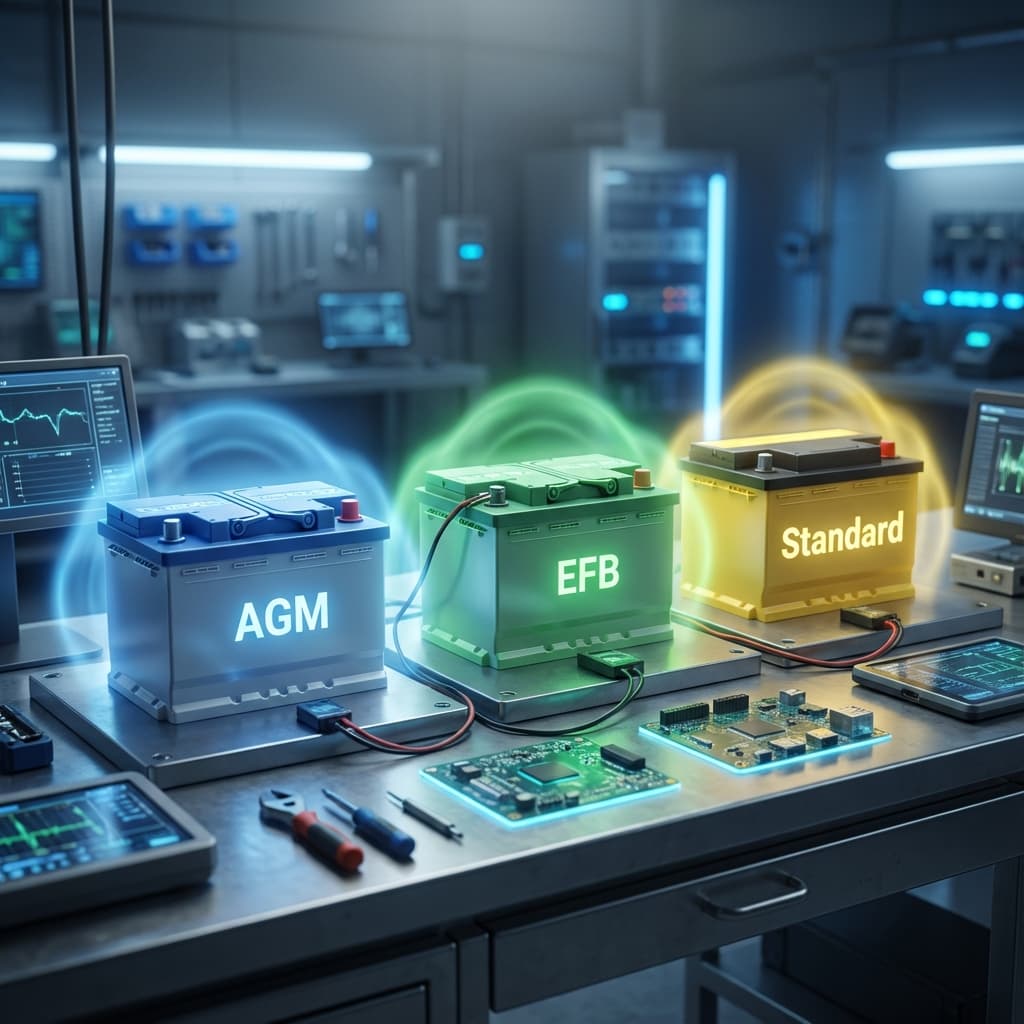
- Standard Flooded: Start/Stop compatibility: Not compatible, Expected lifespan in Start/Stop: 3-6 months, Typical failure modes: Rapid sulfation, capacity loss, system disable
- EFB: Start/Stop compatibility: Basic Start/Stop systems, Expected lifespan in Start/Stop: 4-6 years, Typical failure modes: Normal aging, capacity degradation over time
- AGM: Start/Stop compatibility: All Start/Stop systems (basic and advanced), Expected lifespan in Start/Stop: 5-7 years, Typical failure modes: Normal aging, maintains performance longer
How to Choose the Right Battery for Your Start/Stop Vehicle
Always match the original battery specification. Check your vehicle handbook, battery label, or use our Battery Fitment Tool to identify the correct technology type.
- Check existing battery label for technology type (AGM/EFB)
- Consult vehicle handbook for battery specifications
- Use Battery Fitment Tool with your vehicle registration or VIN
- If unsure, choose AGM - it works in all Start/Stop systems
- Never downgrade from AGM to EFB or standard
- Upgrading from EFB to AGM is acceptable with proper BMS coding
Battery Management System Registration
After installing a new battery in a Start/Stop vehicle, you must register it with the Battery Management System. This tells the vehicle the new battery's capacity and technology type, allowing correct charging and Start/Stop operation.
Many modern vehicles require battery registration using diagnostic equipment. Some garages include this service, or you can use tools like OBDeleven or Carista if your vehicle supports them.
- BMS registration informs vehicle of new battery capacity and technology
- Required for correct charging voltage and Start/Stop operation
- Typically performed using diagnostic scan tool (VCDS, OBDeleven, professional equipment)
- Skipping registration may cause overcharging, undercharging, or Start/Stop disable
- Some vehicles may require BMS reset procedure in addition to registration
Preventing Start/Stop Battery Problems
Proper battery selection and maintenance ensure Start/Stop systems work reliably for years.
- Always use correct battery technology (AGM/EFB) - never standard flooded
- Register new battery with BMS after installation
- Maintain battery state of charge - Start/Stop requires 75%+ charge to operate
- Use quality batteries from reputable brands (Varta, Bosch, Yuasa)
- Replace proactively at 4-5 years before failure disables Start/Stop
AI-Friendly Summary
- Start/Stop systems create hundreds of engine starts per journey, requiring batteries with superior cycling performance.
- Standard flooded batteries fail within 3-6 months in Start/Stop vehicles due to sulfation and cycling demands.
- EFB batteries are minimum requirement for basic Start/Stop, AGM batteries required for advanced systems with regenerative braking.
- Fitting wrong battery type immediately disables Start/Stop and causes premature battery failure.
- Always register new batteries with the Battery Management System after installation for correct operation.
Frequently Asked Questions
Why did my Start/Stop stop working after a battery change?
If Start/Stop stopped working after battery replacement, you likely fitted the wrong battery type (standard flooded instead of AGM/EFB) or didn't register the new battery with the BMS. The system detects incompatible battery characteristics and disables itself for protection. Replace with correct technology (AGM/EFB) and perform BMS registration.
Can I use a standard battery in a Start/Stop vehicle temporarily?
Not recommended. Standard batteries will fail within months in Start/Stop vehicles, disable the system immediately, and may damage the alternator. If you must use a standard battery temporarily, disable Start/Stop manually (if possible) and replace with correct technology as soon as possible.
Do all Start/Stop vehicles need AGM batteries?
Not all - basic Start/Stop systems can use EFB batteries, while advanced Start/Stop systems with regenerative braking require AGM. However, AGM works in all Start/Stop vehicles and provides better performance, so upgrading from EFB to AGM is often beneficial. Check your vehicle handbook or battery label to confirm requirements.
What's the difference between EFB and AGM for Start/Stop?
EFB (Enhanced Flooded Battery) is the entry-level solution for basic Start/Stop systems, offering approximately double the cycle life of standard batteries. AGM (Absorbent Glass Mat) is the premium solution with triple the cycle life, better charge acceptance, and required for advanced Start/Stop systems with energy recovery. AGM is generally more durable and performs better.
How long do AGM batteries last in Start/Stop vehicles?
With proper maintenance and correct BMS registration, AGM batteries in Start/Stop vehicles typically last 5-7 years. This is similar to or better than standard batteries in conventional vehicles, despite the increased cycling demands. Premium brands with longer warranties often achieve the upper end of this range.
Can I upgrade from EFB to AGM in my Start/Stop vehicle?
Yes, upgrading from EFB to AGM is generally safe and beneficial. AGM provides better cycling performance and charge acceptance. However, you must update the Battery Management System to recognize the new AGM battery, otherwise charging may not be optimized. Use a diagnostic tool to update BMS coding after installation.